Posts

Fernand Le'ger "Still Life With a Beer Mug"

Image
  Do you like beer?   How about a huge mug center stage?   That is what this week's image features and it is bright and colorful. It was painted in 1921 by Fernand Le'ger (1881-1955).   If you have studied art, you may see a resemblance to Paul Cezanne and Pablo Picasso in this work.  Le'ger was a very talented French artist, but did not live in a vacuum.  He was part of a large group of extremely gifted artists living in and around Paris in the late 19th century and early 20th century.  What a heady experience it must have been to mix and exchange ideas, thoughts and work.   But the trick of it all, was to come up with something original, great to be influenced, but one needed their own special brand, product.   For Le'ger it was cubism dependent on the cylinder.  It became known for a time as, "tubism"    Le'ger served in World War I at the front, and shortly after that his painting was very mechanica...
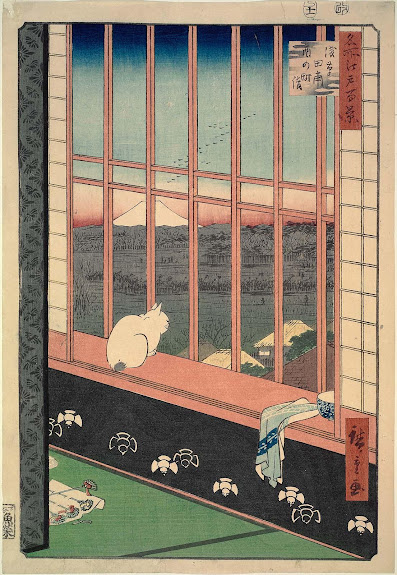
Utagawa Hiroshige, "Asakusa Rice Fields and Torinomachi Festival"

Image
It has been just over a year since we looked at another of Hiroshige's works, and that was from a different series.       Utagawa Hiroshige (1797-1858) was one of the finest of the Japanese artists, and is often considered the greatest landscape artist of his century.  He was hugely influential, especially to European artists such as Monet, Manet, Whistler, and Van Gogh.  I find it sadly interesting that although his paintings and prints were in high demand, selling well, he was poorly paid, never accumulating great wealth. In 1856 he retired to become a Buddhist monk, and at that time began his final series of woodcut prints.  This weeks selection is taken from that series, "100 Famous Views of Edo"  The title of the work is "Asakusa Rice Fields and Torinomachi Festival".     What strikes me the most about this work is how creative it is.  Many of Hiroshige's works were part of a series, so this is not unusual, but who takes on the...

Albert Bierstadt "The Last of the Buffalo"

Image
    I usually stay away from controversial subjects, but for this week, I decided to tackle this one.   The title is The Last of the Buffalo and Albert Bierstadt painted it in 1888.  Here we see a First American on a white horse spearing a bison, with remains of others in the foreground.   What we realize today is that bison were essential for Native People and every part of the animal was important to them and used.  But, in 1888, Bierstadt's goal was to portray a more romantic, glamorous image to the cities in the East, and this painting is the last of a long series he did of the American West.    Bierstadt (1830-1902) was born in Germany, and was brought here as a small child.  He maintained a studio in New York and traveled the West photographing and sketching, then returned to studio to create very large canvases of what was then, a very mysterious land.  He was part of the Hudson River School of artists who believed in ca...

Thomas Eakins "The Biglin Brothers Turning the Stake"

Image
    Probably the most controversial American painter of the nineteenth century was our artist for this week.   Thomas Eakins (1844-1916) was a realist painter and educator who suffered terribly because of his teaching methods, but American culture would most likely be still stuck  in the stifling Victorian tastes and ideals of that century if it were not for Eakins fortitude and personal strength.  As a young man Eakins studied in Europe before returning to his Philadelphia home to work and teach.   From the very beginning he was a strong realist, believing there was nothing finer than to depict nature as beautifully and lifelike as it truly is.  And this interest extended to the human form as well.       In his teaching, life study was essential and he wanted men and women treated equally.  This meant live nude male and female models were used in mixed sex classes - a far cry from the norms of  the day.  ...

Joan Miro, "The Farm"

Image
     A very special thank you to the National Gallery of Art for allowing us to use this painting this week.  The artist is Joan Miro (1893-1983), a Spanish artist usually considered a surrealist.   This past week I did google some information about the painting and read several "expert" opinions on its merit.  Their highly educated views gave me reason to pause, as mine will be a little more "humble".      I have never been to Spain, but I have been to many farms. Because of the nature of the business, they all have many things in common, and we see them all portrayed here. Without background history, viewing the painting on its own merits, it is amazing to see all Miro has included.  Everything is here!  As our eyes scan across the canvas all kinds of life and objects are discovered; even a snail!  Miro must have loved this place.        The landscape is divided in half horizontally, with the bot...

Winslow Homer "On the Stile"

Image
If you checked in early, you will have noticed I changed paintings for this week.  I discovered my original selection needed permission to be used. So hopefully, we will be able to use it in the future.  So, today we have a sweet and romantic substitute.     Winslow Homer (1836-1910) is our artist, and he did this painting in 1878.    On the Stile is the title, and not knowing what a stile is, I looked it up. Stile are the steps which allow the young people to pass over the fence that is a barrior to sheep or cattle.     Homer created this work during his mature period.   Previously he had earned income as an illustrator depicting scenes of rural New England life, near where he lived.  When the Civil War broke out he was at the battlefield recording the life and horrors of war.   So now, in 1878, he has seen war, traveled to Europe and has fully matured as a complete artist.  He returns to his home area and ...

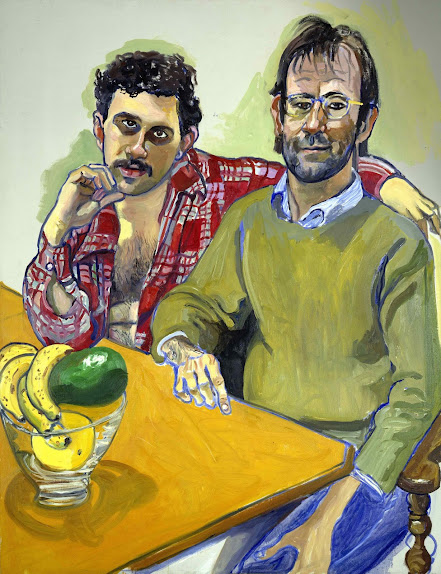
Alice Neel, " Geoffrey Hendricks and Brian"

Image
  Of all the subject to select from in painting, I believe portraiture can be the most difficult.  Not only must the artist be able to handle the medium, but also to capture a likeness, usually to satisfy the tastes of the subject.   So today we have one of the greatest portrait painters of the late 20th century, Alice Neel, (1900-1984).      This painting is taken from a career-spanning exhibition of her work that is now at the Metropolitan Museum of Art in New York, which is a huge accomplishment signifying the acclaim she is now experiencing some 40 years after her death.     Neel had an extremely difficult life which I will not write about, but she is worth Googling.  What I want to write about is this painting.  It was done in 1978 when she was living in New York City.  I hope you find it as amazing as I do.     Let me point out a few things: first, much of the figures are outlined in a bright blue...