Posts

Da Vinci and Agasse, two portraits
Image
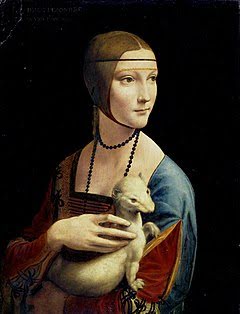
   Here we have one of my favorite Leonaro Da Vinci paintings.   It is titled, Lady With An Ermine and was painted about 1490 when Da Vinci was 38 years old.  It is an oil on walnut and is the property of the National Museum Czartoryski in Krakow, Poland.    This is a beautiful, realistic image that is very striking.  Da Vinci decided against a background (as he used in Mona Lisa )  in favor of creating great contrast between the flesh tones and rich blacks.  So it is only the woman's dress and the ermine that suggest who she was and what her interests were.     Many years ago when I saw the Mona Lisa at the Louvre I was amazed at the beauty of her hand, and here again, he has rendered the hand with great skill and tenderness.  But my attention is drawn to the ermine.  How did he do this?  It is amazing.  The animal seems to be looking the same direction as the lady, so soft and such a tender relationshi...
Autumn Boulevard, Paris

Image
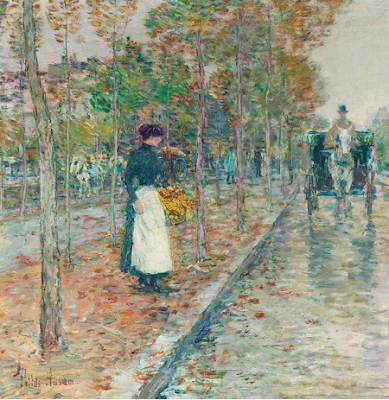
   Today's image is an oil painting by American Impressionist, Childe Hassam (pronounced child, hass'm) titled Autumn Boulevard, Paris.  It is in a private collection.    It was painted sometime between 1886-89 when Hassam spent 3 years in Paris studying European painting.  There is no evidence Hassam ever met Monet, Renoir or others as the French group of impressionists had pretty much dissolved as a group by 1886, the time of their last and final exhibit.  But obviously, Hassam captured the spirit of the movement and brought it home to New York.    This beautiful image is an unusual composition.  Here the center of attention bounces from the horse and carriage to the woman waiting at the curb.  The line of the curb draws the two together, plus the evenly spaced row of trees acting as a rhythm pattern moving the eye across the canvas.   The color harmony is blue/green to orange/red, another complementary arrangement....

Renoir: Children's Afternoon At Wargemont

Image
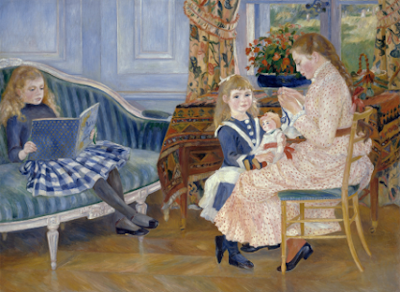
  Here is Pierrre Auguste Renoir's beautiful painting Children's Afternoon at Wargemont from 1884.  The original painting is in the collection of the Alte Nationalgaerie in Berlin, Germany.     Renoir was at the height of his career when he created this work in 1884.  Here we see three girls in an interior space.  The flowers and view out the window indicate it is summer, maybe late spring.  The room's decor and the girl's dress suggest a prosperous French family.  The oldest girl is hand sewing, the middle, reading and the youngest loves her doll and oldest sister.     If you have read my previous blogs, you may have an idea why I selected this painting for review.  Obviously it is a beautiful image, and I can imagine seeing the original is spectacular for Renoir knew how to use color to its best advantage - pure, clean and bright.  The composition is particularly interesting.  Similar to the Kirchner and the Vermeer ...

Mucha Lithograph, Four Seasons, Winter

Image
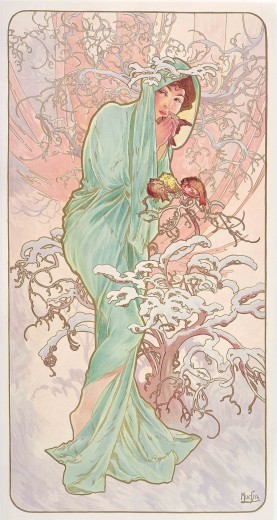
    1896 is the year Alphonse Mucha created a series of four lithographs titled: Four Seasons  The one for today is Winter .   It is the height of the design movement titled Art Nouveau, and Mucha is a master of the style.  Here we see a lovely woman out in the snow draped in a form fitting soft green fabric.  She has cupped a bird in her palms, lovingly bringing it to her mouth, where we can assume she is warming it with her breath. Such a beautiful image, and such a warm, wonderful sentiment.    So let us examine the composition.  Here again the work is based on a complimentary color harmony: soft pink/reds, and soft blue/greens.  She is standing in the midst of a snarly tree done in light grey and white which contrasts with the softness and sensuous quality of the draped fabric. Warming the format in the far background, is a pink swirl of color framing the upper portion. The figure pops because of the contrast of color and becau...

Hopper's Room in Brooklyn

Image
  Today's painting is Edward Hopper's:  Room in Brooklyn.  It is an oil on canvas and is part of the permanent collection at the Museum of Fine Arts, Boston, painted 1932.    Hopper is one of my favorite American artists, and for the purpose of this writing, I want to put aside all I know, and just examine this image.    The composition is amazing.  It is built on rectangles and lines. Framed by two white vertical lines, they are repeated in size by the brown window frames. The top is cemented with the shades, notice the two on the left and right are exactly the same, with the left one slightly lighter in color.   The top half is all window, with the horizontal brown lines dividing that space.   The exact middle, and all inside the window frame is the woman's head, the top of the far buildings and the flowers.   In the lower section, the base is the same basic color as the shades, with the rectangle of light pulli...

Vermeer's Street in Delft, a review

Image
    Today's subject is a landscape, Jan Vermeer's Street in Delft.    As with other paintings examined, I will write about this one as if I know nothing of Vermeer, a little of Holland or Delft.   Again, the object is simply to enjoy the painting by finding the clues left by the artist.     First the composition.  The painting has a design very similar to the Kirchner painting, Bergheuer reviewed in March.  A light yellow base cements a huge triangle coming from the right balanced by the triangle of the sky and smaller shapes to the left.  The angle of the line in the cobblestone street breaks up that rectangle, sending our eye right into the little alley.  Also notice the left edge of the major building (on the right) is dead center.   So huge an object to weight down the whole right side, but it does not - why?  I think because the facade of all the building fronts are punctuate with windows and doors.  ...

Review of Vighi portrait

Image
   Many years ago when I was teaching photography,  classes were asked to arrange portrait compositions by adding objects and even selecting poses indicative of the subjects interests, personality.  The object of course is for the viewer to immediately gain understanding without knowing the individual, or seeing the title.    So our subject for today is Cagnaccio di San Pietro's portrait of Signora Vighi for 1930 - 36. Let us examine the image by what the artist allows us to see.     First:   what is in the painting?   A woman is sitting in a chair with a book on her lap.  Behind her and next to her on the floor are a couple of brocade pillows. On her side table is what looks to be a little toy chicken and dog!   Now why have they been included?  Knowing nothing of Ms. Vighi we have to assume she could be involved with animals somehow, and maybe children.  Maybe these toys represent her two kids?...