Posts

must skip this week

 Dear Viewers, due to a death in my family, I will not be able to post this week, as I am out of town. I will be back next Monday, so please return.  I will try and find something exciting and wonderful to show you. Pat 

Egon Schiele, "Port of Trieste"

Image
     Future of this blog is in question as I may have to take off a few weeks for my viewership is down for the summer.   Also, this past week I lost a dear viewer, but, at the present, as long as I have images to show and my dear friend, Char is still with me this blog will go on.    I have showed you a Egon Schiele (1990-1918) landscape before this one, but it has been a while.  I am not drawn to a large majority of his work, but his landscapes are always a unique experience.  This one attracted my attention because of the color and then the media.  It is an oil and pencil on cardboard.  Give that some thought.    Today's cardboard is not considered a suitable surface to work on or even mount a paper on because of the acidity, but hopefully in 1907 cardboard was constructed differently.      I do not work in oils.  It is a marvelous media but it does have a distinctive odor and it takes months for it ...

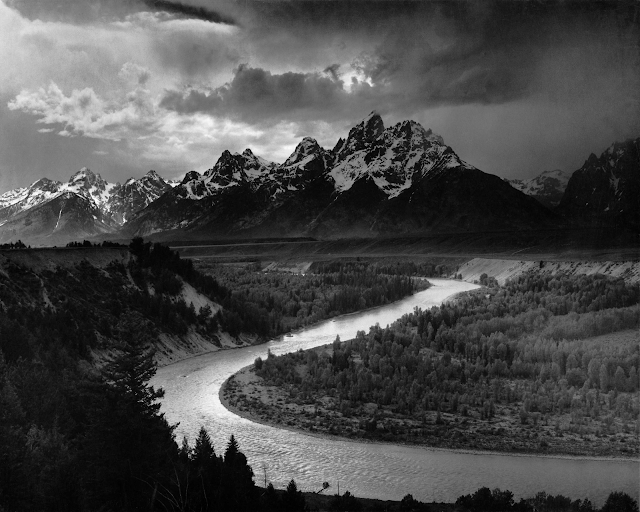
Ansel Adams, "The Tetons and the Snake River"

Image
     I have always considered art photography a beautiful and mysterious means of expression.  It's biggest problem is that unlike many other forms of Art, photograph is often used for a wide variety of purposes, so the pure Art does get lost, tossed and mixed up in advertising, self promotion, and a host of other things.   This is not necessary bad, but simply only a product of it's success.    When a painter selects his/her subject, sketches are made and vistas can be arranged and rearranged to suit the all important composition.   A photographer does not have that luxury.   When  Ansel Adams (1902-1984) took this photo he didn't just reach in his pocket and whip out his phone.  I have no idea how far he walked to see this landscape, but realize, it was necessary for him to set up a tripod, connect the large, heavy viewfinder camera to it, determine the correct camera settings, and then wait for the natural lighting...

Patricia Beckmann "Midnight"

Image
 This week I am waiting for a friend to send me one of her paintings so I am posting an old collage of mine. It is one of my favorites.   I have done collage for many years and have collected a large variety of papers and images.  It is a fun, but difficult process.  I find it a great way to express myself, but it is time consuming.     I probably spent three to four months on this image.  It is not large, but complex.  I love looking over it and rediscovering designs, and mini images.  After looking small, look at the whole and see the flow of one paper into another, the rhymn from top to bottom, left to right, and diagonally down.    This is one of the few monochromatic works I have ever done.  My memory is that I saw this as a challenge and I wanted to tell a little story with it.  So, if you want to, scan the image and imagine.    I used a large variety of paper.  Some photo paper, some tissue, maga...

James Tissot, "Young Lady in a Boat"

Image
     I first saw this last week in my favorite art calendar.  Isn't she beautiful! I had read about the artist before, but knew little about him, however just by looking at this painting I knew it was a commissioned portrait.   We often forget that most career painters need to make money, a living.  And, portraits of society people (who could afford it) was often an artist's choice.   Looking at this beautiful image, it almost makes me wish I was a society lady in France, 1870.  I would want James Tissot to make me look this wonderful!      Looking closely at this painting poses a few practical questions.  First, James Jacques Joseph Tissot (1836-1902) was French and generally knew and accepted with the Impressionists, but he never exhibited with them, or the Post-Impressionists.  A year after this painting was completed, in 1871 he moved to London where he continued an active portrait business.  I will note...

Sandra C. Swenson, "Summer Flowers"

Image
We haven't looked at a still life in a long time so when Sandra sent me a series of paintings to use, I selected this one. Isn't it beautiful!      Sandra is one of those people who you know young, send many years apart and reconnect later in life.  She had a great career as a junior high art teacher and since has taken many painting classes perfecting her craft.           I like this work for many reasons.  One is the background. Without a division line she has created space and light.  We don't know what is in the rear, for she insists we focus on the flowers and vase.  Pay attention to the transition of color in the foreground.  We can tell immediately light is coming from the upper left.  Notice the beautiful transition from white/pink to soft blues.  Skillfully done!     As I have written before knowing when to stop is often a difficult dilemna.  Here Sandra has done a ...

Grace Galvin, "The Old Abandon School House"

Image
     Watercolor painting is a great skill often achieved after years of practice.  This week we have a friend of mine whose work I have long admired.  Just like Char two weeks ago, Grace has a definite style and way of working that gives her paintings a unique appearance.     Here is what Grace says about this painting:       I painted this watercolor from a reference photo taken from outside my hometown in Indiana.  I just completed an art exhibit there that was in conjunction with the Bicentennial of the county.  I painted 30, 8 x 10 inch watercolors of historic homes and buildings in the area, and this was my favorite of the paintings.     The subject is an old abandoned one-room school house.  I like the composition and the feeling of loneliness of a building that once held a lot of life and happiness.  The old tree in the foreground adds to the drama.     Working from a photograp...

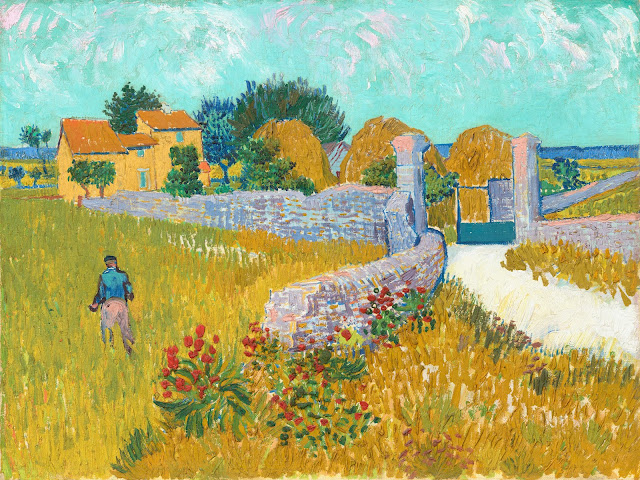
Vincent Van Gogh

Image
     The guest artist for this week has had technical issues and so for several reasons this week we will look at this wonderful landscape by Vincent Van Gogh.  A week ago I wrote at length about Char's skill plein aire painting in watercolor.  Van Gogh painted out-of-doors, too, but in oil paint.  His technique was to execute the drawing and establish all color outside by thinning the paint to an "oil wash".  He would then go indoors to complete the painting with heavy layers of paint until complete to his satisfaction.    Oil paint is considerably different to work with from watercolor.  Both have their own challenges. Watercolor dries quickly and artists usually work in fine, thin layers as the paint is transparent color. Oil dries very slowly, so color can be mixed and adjusted on canvas if necessary and as needed.      Next week I will introduce you to Grace who will demonstrate her method of creating a painting....

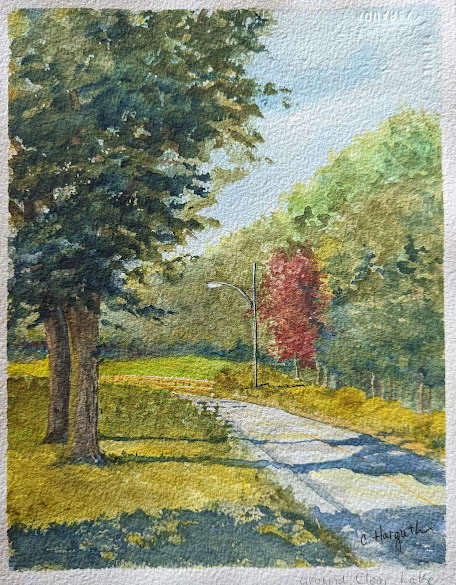
Char Harguth, " Outdoor Landscape"

Image
   One of my fun memories was summer months plein aire painting with this week's artist. Since that time, I have met others who have  painted outdoors.  While Char and I set up chairs and easels in the grass, others have worked in their cars so as not to attract public attention.  I remember one specific day we were in an area park and a woman saw Char and was so curious she had to come visit and watch.   Although it was a friendly, sweet thing to do, it broke our concentration and we were unable to continue.  I know Monet painted in a boat on the river, maybe, also, to avoid the friendly public.       The painting Char has selected to share is beautifully executed.  It is perfectly balanced.  Notice how important the light post and small red tree to balance off the right side from the left.  The blue shadow, below, establishes a nice "base, off setting the heavy left top.  The curve of the road, is almost a...

Patricia Beckmann "Yellow Flower"

Image
   When I moved to my new home five years ago, I wanted a couple of flower paintings to brighten  up an outdoor deck for summer months.   I ended up doing a whole series in different sizes, simply because they were fun to make.   Of all of them, this one is one of the ones I enjoy the most.  It now hangs in my dining area year round.     Do not try and give a name to it, as I did not look at a specific flower. This one grew out of my imagination.  Unfortunately when I took the photo I could not remove the glare visible in the upper left, so please excuse.     I "read" several things into this image.  To me, it has a slight "Georgia O'Keeffe"  quality.  I was very pleased with the colors, especially the blues.  There was no attempt at creating foreground or background, only please shapes of color.  I have no problem with art created simply to decorate a space.  Actually, I have come t...

Changes being considered

 Dear Readers,     I think it is time to give this blog some new life.  I am considering asking painters and artists I know to contribute work.   The work would be published just as the great masters have been, in a very positive, supportive environment.  The artist would be asked to write a few lines about the work and tell a little about themselves, with nothing confidential.  This blog would not sell work, but if the artist desired, they could include an email address so they could be contacted if readers had questions.       Old Master work would still be included, especially when no "local" painters are available or interested.        I am going to begin this week by including one of my own paintings and hope that next week a friend will consent to submitting. Pat 

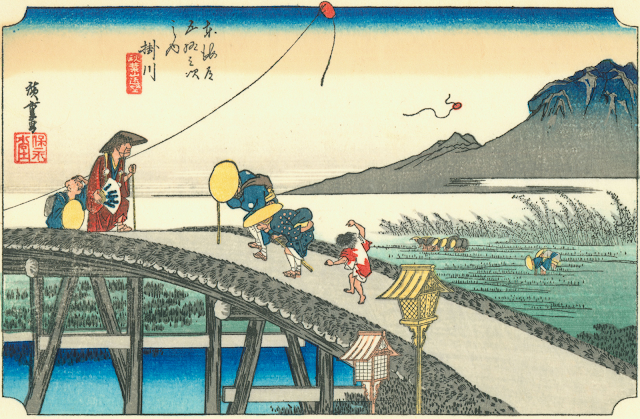
Utagawa Hiroshige, "Kakegawa"

Image
    This week we are returning to one of my favorites.  We last visited this artist and this series back in September of last year.  His name is Utagawa Hiroshige (1797-1858).   He was a Japanese wood block artist who created a huge inventory of prints featuring Japan, his homeland.   After traveling along one of the five main roads linking the cities of Japan, Hiroshige made prints of the stations along the one called the Tokaido Road.   This road linked Shogun capital, Edo to the imperial capital, Kyoto, so it became the main travel and transport artery of old Japan. The road had 53 stations offering food, rest and lodging to travelers.   There are 55 prints in the series because Hiroshige created one for travelers starting their journey and a final for ending it.       When this series was completed, it was immediately popular.   They were very small, a mere 6 11/16 inches high by 9 inches wide,...

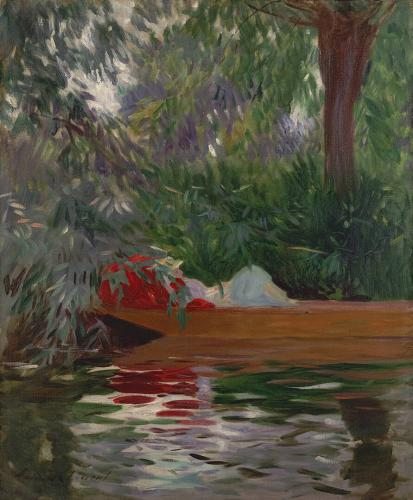
John Singer Sargent, "Under the Willows"

Image
  I always feel the first week of June marks the real beginning of the first week of summer.  So let's look at a very summer painting.    And, isn't this an ideal, idle activity.  We know little, only see the profile of a woman leisurely reclining in a boat on the water.  Has she fallen asleep?  Is she reading? Is she waiting for someone to join her?   She only looks relaxed, and easy for us to envy her.      This is an oil painting by American expatriate artist, John Singer Sargent.  We don't know the location, but best to assume it is in Europe, or Britain as Sargent spent most of his life there.      The composition is pretty straight forward.  Our white subject is just below center,  framed in orange/red against a complementary green setting.  The tree on the right forms a nice structure and the direction of leaf structures help to point the way down to our relaxed lady.   I...

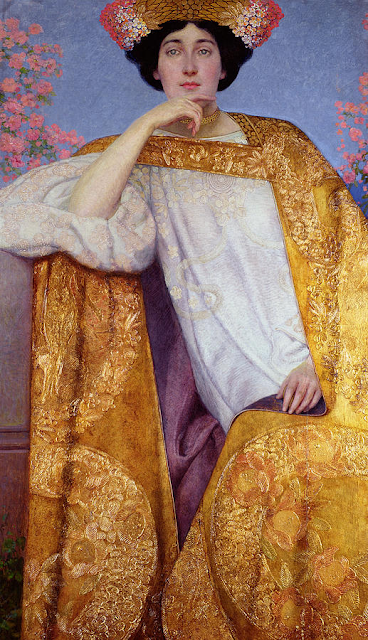
Gustav Klimt * "Portrait of a Woman in a Golden Dress"

Image
   This week I give you some heavy eye candy!  This is probably a poor choice as there are a lot of unknowns about this painting, possibly more unknowns than knowns.  But this painting has always interested me.    I first learned of Gustav Klimt (1862-1918) as a student, many years ago, but it wasn't until recent reading that one author called a spade a spade. He acknowledged that Klimt was not a major artist, he broke no ground, did not further any art movement.  He just made pretty pictures.    But, his paintings were so "pretty" Hitler and the Nazi's snatched them up and held on, thus creating new post war conflicts on ownership.    Klimt's family was in the gold business, so it was a natural extension for him to incorporate the metal into paintings, of which this painting is a prime example.  Our figure is positioned straight center, and looking out at us. Obviously, her beautiful porcelain skin has never seen the ligh...

Henri de Toulouse-Lautrec, "A Corner in Moulin de la Galette"

Image
   This week let us look at an artist who lived a very short life, but has been on the forefront of art history for a long time.  When I think of Henri de Toulouse-Lautrec (1864-1901),  I think of an artist, with Vincent Van Gogh, who was enough of an unusual person, that somehow their collected image came to illustrate the stereotype of the artist.   Toulouse-Lautrec was an outsider who because of physical abnormalities never fit in with other persons of his class, and so, he found comradeship in the dance halls and brothels of Paris.   Much has been written about his short life, for he was a dedicated artist, creating a huge number of paintings, drawings, and posters.  His mother was a large influence providing him with a living long before his art began to sell.  Eventually, it was income off posters that gave him money of his own.         Our painting this week is a typical one for him.   We see a g...

Piergiogio Branzi, "Florence, Alley in Via del Corso"

Image
           I am sure most of you have realized that this week we are not looking at a painting, but rather at a photograph.   In seeking new works for this blog, I came across this work and knew I had to include it.  Some of you may know I used to teach photograph at the high school level, so have always been drawn to the medium as an Art form and view it no differently than a painting.  The artist simply created the image using a different process.   In the expanded world of photograph there are several classifications and Art photograph is simply one, and that is the one we discuss this week.       I did not know of Piergiogio Branzi, and since have discovered he was born in 1928 and is still living.  He was born in Florence, Italy, the very location where this image was created.   Since discovering this artist I have looked at many of his creations from this period and have been amazed....

Edward Hopper "Office at Night"

Image
   Let's go back a few years and find a scene of unspoken drama.  Edward Hopper is our artist (1882-1967), a man who lived in New York City and spend many hours going to the movies. Maybe he picked up the idea for this painting from one of them?     Let's pick out some of the elements of the painting that help create this dramatic scene:    First, the window shade, it's moving!  The window must be open and a breeze is coming in to cool a warm room, without air conditioning.  Looking on the floor, beyond and a little behind the desk, we see a paper has blown to the floor.      On the lower left corner is another desk. Since it contains the typewriter, and the man's desk does not have one, it is safe to assume this is the woman's desk and he is her boss or supervisor.  Having both desks in the same room indicates it is a small firm.   Notice her desk is not luminated as his is.     The ligh...

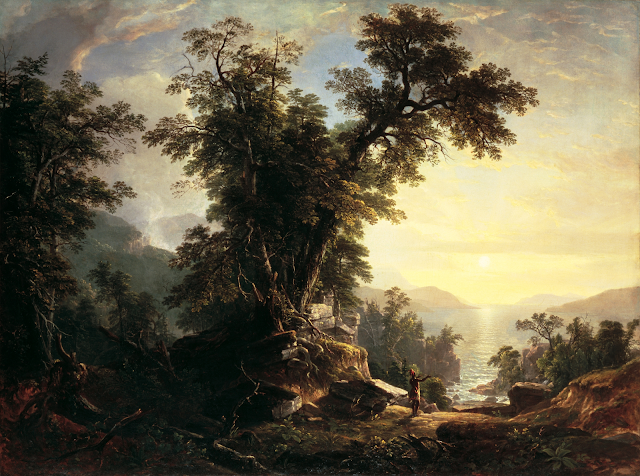
Asher Brown Durand, "The Indian's Vespers"

Image
     It has been a long time since we looked at an American landscape, so that is our topic for this week. Our artist is Asher Brown Durand (1796-1886).  He was a member of the Hudson River School, who were a group of artists devoted to painting the Hudson River Valley, the Catskills and Adirondack areas of the American East. Although each painter adopted his own set of objectives, basically they romanticized the area, making it lusher and more idyllic than actual life. They also included everything!   Far more than a person's eye can absorb if on the actual scene.     One thing that is interesting about this is that it was very popular.   This painting was completed in 1847, long before photography, so a landscape painting was the only means city people could see the great wilderness out there, beyond their homes.  So to study all of nature in one image was wonderful.      In 20 plus years, especially in Fr...

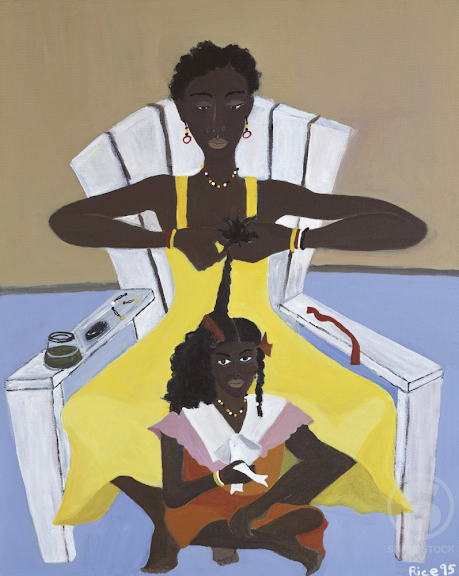
Arnold Rice, "Braids"

Image
    Ready for a mystery?   Unfortunately I must present one today.  Our artist this week is Arnold Rice and I could not find any information about him!  It is known that he created this work in 1995 and it is now in a private collection.  So this is all the information I can provide.  It is a mystery.     Yet this painting is compelling.  I find it amazing.  Symmetrically designed compositions are very difficult to find.  Often an artist does not use this system of balance because it is considered to confining, limiting freedom of expression. . But obviously and happily, Mr. Rice didn't get that memo!     Let's look at color first:  Blue, brown/orange and yellow (in paint, black is considered the total of all color, white the absence). Rice uses them almost flat, meaning little attempt at creating depth, shape.  The yellow dress is the perfect example. Only under, behind the girl do we see the curv...

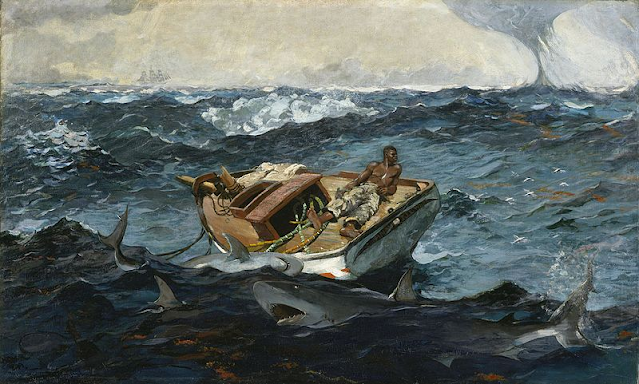
Winslow Homer, "The Gulf Stream"

Image
     A dear family member sent me an article last week about Winslow Homer (1836-1910) and this painting.  The article tossed out several theories of what Homer intended in this work.   There was enough discussion of it's meaning while he was still alive, so he wrote an answer, an answer I loved!   The thrust of it was disappointment, feeling that between the title he chose, and the image, if the painting was successful, then the meaning should be clear.      As I have often written, we must come to Art from out own feelings, background and experiences.  It is possible to interpret this painting in several very valid ways.   It is a great work of Art, and has been recognized as one of America's finest paintings.  Allowing it to have significance beyond Homer's original intent is just fine, but please do not confuse the two.       To consider Homer's meaning we should examine his title:...